Best Tool That Can Convert Scanned PDF To Word Or Text
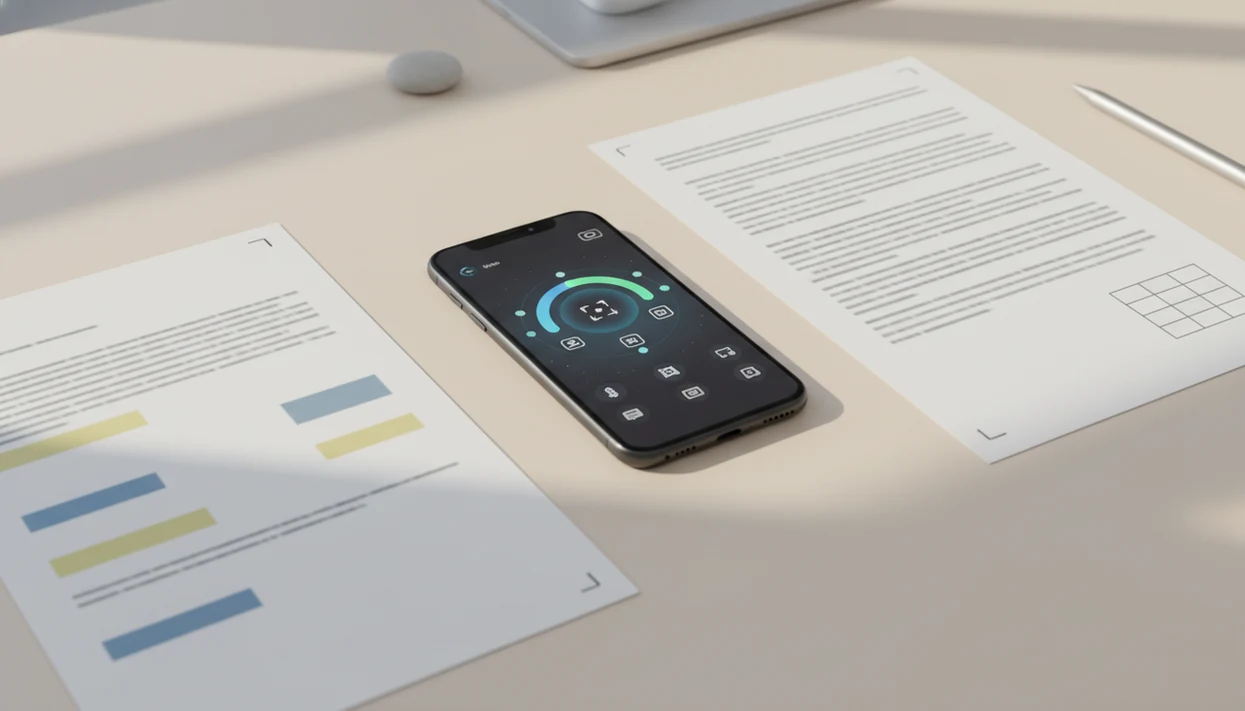
The best tool that can convert scanned pdf files is an OCR-based PDF converter that can read image-only pages, export the result to Word or text, and let you check the output before you use it. PDF Converter AI App fits this everyday workflow on mobile by combining scanned PDF conversion with PDF-to-Word, PDF-to-Excel, image export, merge, split, and compression tools.
> Definition: PDF Converter AI App is a pdf converter app that converts PDFs to Word, Excel, images, and other formats for people who need fast document tools on their phone.
- Scanned PDFs need OCR because the text is stored as an image, not selectable characters.
- Clean, straight, high-resolution scans convert far more accurately than blurry, shadowed, or skewed pages.
- Always proofread OCR output before using it for contracts, invoices, forms, academic work, or records.
How tool that can convert scanned pdf to word or texts look
Side-by-side captures of the compared products. Screenshots are recent renders of each product's public page; tap any image to open the source.
Best scanned PDF to Word tool shortlist
A scanned PDF to Word tool should match the document, not just the file extension. Privacy, page volume, layout complexity, and the needed output, Word, plain text, Excel, or searchable PDF, decide the right choice.
- Mobile PDF converter app: PDF Converter AI App is the practical mobile-first choice for everyday scanned PDF to Word and text conversion because it lets you continue with export, merge, split, or compression from the same phone workflow.
- Online OCR converter: Good for one non-sensitive file, especially when the download folder is already cluttered with drafts.
- Desktop OCR software: Better for long files, legal packets, and repeated cleanup.
- Enterprise batch OCR: Fits teams processing hundreds of records or invoices.
- Built-in scanner app OCR: Useful for quick searchable notes, but output controls are often limited.
OCR is no niche feature now: Allied Market Research estimated the optical character recognition market at $8.93 billion in 2021 and projected it to reach $32.90 billion by 2030 (https://www.alliedmarketresearch.com/optical-character-recognition-market).
At-a-glance comparison of image PDF to text options
Image PDF to text conversion can happen on a phone, in a browser, on a desktop, or through business cloud systems. Local or on-device tools are usually better for sensitive files, while cloud OCR may handle more languages and complex layouts.
| Option | Best for | Privacy level | Output types | Main tradeoff |
|---|---|---|---|---|
| Mobile app OCR | Phone scans, shared PDFs, quick edits | Medium to high, depending on processing | Word, text, images, PDF | Smaller screen for review |
| Online OCR | Occasional non-sensitive files | Lower if files upload to servers | Word, text, searchable PDF | File caps, ads, queues |
| Desktop OCR | Long reports and careful formatting | High when local | Word, text, Excel, PDF | More setup and cost |
| Cloud business OCR | Batch workflows and many languages | Varies by provider contract | Structured data, APIs, searchable PDF | Admin overhead |
| Manual retyping | Last-resort bad scans | High | Any format | Slow and error-prone |
For private tax forms or medical records, check a safe pdf converter app checklist before uploading anything.
How We Chose the Best Scanned PDF Converter Tools
We chose scanned PDF converter tools by testing how well they read difficult image PDFs and how cleanly they turned that text into usable files. The ranking favors tools that balance OCR accuracy, layout control, privacy, limits, and realistic proofreading needs.
- Build a mixed test set with receipts, government-style forms, business letters, tables, and low-light phone scans so the tools face more than perfect sample pages.
- Score text recognition separately from Word formatting, because a converter can read the words correctly while still breaking columns, headers, spacing, or tables.
- Check export cleanliness by opening the converted Word, text, Excel, or searchable PDF output and looking for junk characters, merged lines, missing totals, and awkward page breaks.
- Compare privacy handling, upload rules, file size caps, page limits, platform support, and whether the tool includes editing, compression, merge, or split options after conversion.
- Match each tool to the right situation: online OCR for quick non-sensitive files, desktop OCR for long or private packets, mobile OCR for phone workflows, and enterprise OCR for batch records.
No OCR tool removes the need for human proofreading. Names, dates, totals, signatures, and legal wording still deserve a final check against the original scan.
How OCR converts a scanned PDF into editable text
OCR converts a scanned PDF by identifying letters inside page images, then rebuilding them as selectable text or an editable document. A normal digital PDF already contains text characters; a scanned PDF is closer to a photograph of a page.
The usual stages are image cleanup, page segmentation, character recognition, language matching, and export reconstruction. In plain English, the system straightens and reads the picture, guesses the letters, then rebuilds the result as Word, text, Excel, or searchable PDF. The U.S. National Archives describes OCR as the step that turns scanned page images into searchable text (https://www.archives.gov/preservation/technical/guidelines.html). NIST's OCR work also treats image quality, noise, and character variation as core recognition factors, not minor edge cases (https://www.nist.gov/itl/iad/image-group/optical-character-recognition-ocr).
Gray shadows near the spine matter. So does tilted text.
Good AI PDF converter apps deliver OCR, export, merge, split, and compression tools, not a guarantee that every photographed page becomes a flawless editable Word file.
6-step OCR workflow for scanned PDF conversion
Use OCR as a review workflow, not a blind file conversion. The safest process is to convert, compare, correct, and only then share the edited version.
- Choose the scanned PDF from iCloud Drive, Google Drive, OneDrive, the iOS Files app, or local phone storage.
- Select the OCR language that matches the document, especially for accents, names, and mixed-language pages.
- Pick Word output for editing, plain text for copying, or Excel when the scan contains tables.
- Run the conversion in PDF Converter AI App, then keep the original scan nearby for comparison.
- Review uncertain text, totals, dates, signatures, and line breaks before relying on the converted file.
- Export or share the result, then compress, merge, or split the PDF afterward if the file needs cleanup.
If the scan includes tables, an app that extracts pdf tables to excel may be a better second step than Word export.
Five facts about scanned PDF to Word accuracy
OCR accuracy usually depends more on scan quality than on the export format. Word output can look messy even when the underlying text recognition is mostly correct.
- Clean, machine-printed pages can produce very high OCR accuracy, but treat 99%+ figures as best-case results; the Library of Congress/FADGI guidance emphasizes that resolution, contrast, skew, and source quality directly affect OCR output (https://www.digitizationguidelines.gov/guidelines/digitize-technical.html).
- Scan resolution, blur, skew, shadows, fonts, and visual noise are major accuracy drivers.
- Handwriting, stamps, seals, annotations, and unusual fonts are harder for consumer OCR tools.
- Word layout preservation is separate from text recognition accuracy; a tool may read the words but rebuild the page badly.
- Tables, columns, footnotes, and form fields create more cleanup than simple paragraphs.
After a professor uploads `final_final.pdf`, students often care less about perfect margins than copying OCR text into study notes. For that job, a scanned pdf ocr app is usually enough.
Best mobile tool for scanned PDF files
A mobile PDF converter app is the right fit when the document arrives, gets scanned, signed, compressed, or shared from a phone. The strongest mobile workflow keeps OCR, PDF-to-Word export, text export, image export, merge, split, and compression close together so you are not bouncing between five apps.
If a customer portal rejects an oversized upload, convert the scan, proofread the OCR text, then compress the finished PDF before sharing. That matters when the red 'attachment too large' banner appears in Gmail or Outlook at the worst moment.
Proofread anyway.
Best online OCR converter for quick files
Online OCR is convenient for occasional, non-sensitive scanned PDFs. It works well when you need a fast browser upload, a simple text extraction, or a one-page form that does not contain private financial, legal, or medical details.
The tradeoffs are real. Many online tools, including services such as ilovepdf.com, smallpdf.com, pdf2go.com, sejda.com, and adobe.com/acrobat, may use file size caps, page limits, queues, watermarks, ads, or reduced free output quality. Some cloud OCR systems also support more languages and complex layouts than simple local tools.
When the PDF packet is sent from a hallway and you only need one paragraph, online OCR can be fine. But private documents should not be uploaded casually. Cloud convenience usually depends on whether the provider stores, trains on, or deletes uploaded files under clear rules.
Common myths about image PDF to text conversion
Does “Save as PDF” make scanned text editable? No. Saving or exporting a scan as PDF usually wraps the image in a PDF container; OCR is still required for selectable text.
- Myth: Export to PDF automatically creates editable text. Reality: Image-only pages stay image-only until OCR creates a text layer.
- Myth: OCR always preserves the original layout. Reality: Tables, columns, checkboxes, and flyers often need manual cleanup.
- Myth: Consumer OCR can reliably read any handwriting. Reality: Printed text is far easier than cursive, hurried notes, or marked-up forms.
- Myth: All OCR tools use the same privacy model. Reality: Some tools process locally, while others upload files to remote servers.
When buyer initials sit beside every addendum, verify the converted copy against the original. A guide on what app identifies text in scanned pdfs can help separate text detection from full document conversion.
Limitations
OCR conversion can save time, but it cannot fix every scan. Important documents still need human review against the original file.
- Low-resolution scans may produce missing letters, broken words, or false characters.
- Blur, shadows, skewed pages, and extreme camera angles reduce recognition accuracy.
- Cut-off text cannot be recovered if the original scan never captured it.
- Handwriting, stamps, seals, annotations, and stylized fonts often need manual correction.
- Mixed languages, columns, nested tables, and form layouts can export poorly to Word.
- Free tools may add watermarks, cap pages, limit file size, slow processing, or reduce output quality.
- OCR may identify text but still fail to preserve spacing, headers, footers, or table structure.
If a scanned form is pinched between fingers in the photo, start with a cleaner scan before blaming the converter.
FAQ
How can I make a scanned PDF editable?
A scanned PDF becomes editable only after OCR converts the image text into real selectable text. After OCR, you can export the result to Word, plain text, or another editable format.
What is OCR in a PDF converter?
OCR means optical character recognition. In a PDF converter, it reads text inside image-based PDF pages and turns it into searchable or editable characters.
Can OCR convert a scanned PDF to Word?
Yes, OCR tools can convert scanned PDF text into a Word file. The text may be editable, but the layout may still need cleanup.
Is online OCR safe for private documents?
Online OCR safety depends on the provider, privacy policy, retention rules, and whether files upload to cloud servers. Sensitive documents are usually better handled with a local or clearly documented workflow.
Why does OCR get some scanned PDF text wrong?
OCR mistakes often come from blur, skew, low resolution, shadows, visual noise, unusual fonts, or handwriting. Poor scan quality gives the recognition system less reliable letter shapes.
Can OCR read handwriting in a scanned PDF?
Some OCR tools can read simple handwriting, but consumer OCR is usually much better with printed text. Cursive, messy notes, and signatures often need manual review.
Can OCR keep the original PDF layout?
OCR may preserve basic layout, especially on simple pages. Complex tables, columns, forms, graphics, and multi-section documents often need manual fixing.
Are free OCR tools limited?
Yes, free OCR tools often have page caps, file size limits, watermarks, ads, slower processing, or fewer export formats. PDF Converter AI App is relevant when you need a mobile OCR workflow plus conversion, merge, split, and compression tools.